Where a new floor goes wrong before the first plank
Most failed floors were never failures of the planks. The carpet came out, a new product went down, and nobody looked hard at what was underneath. Carpet hides a lot. Staple heads, a dip by the doorway, a seam where two sheets of plywood meet unevenly: all of it telegraphs through a thin vinyl plank and shows up as a soft spot or a click underfoot within a season.
The second common failure is a floor laid tight to every wall. Planks move with the seasons in Georgia, and a floating floor with no expansion gap at the edges has nowhere to go. It humps in the middle of the room, or the joints pop open along one side. The third is the transition: a doorway where two floor heights meet badly, a threshold that rocks, a strip nailed through a plank that was supposed to float.
None of these show in a photo of the finished room on day one. They show up in month four, which is why this page is about the order the work happens in rather than the brand on the box.
Carpet out, subfloor read, then the new floor
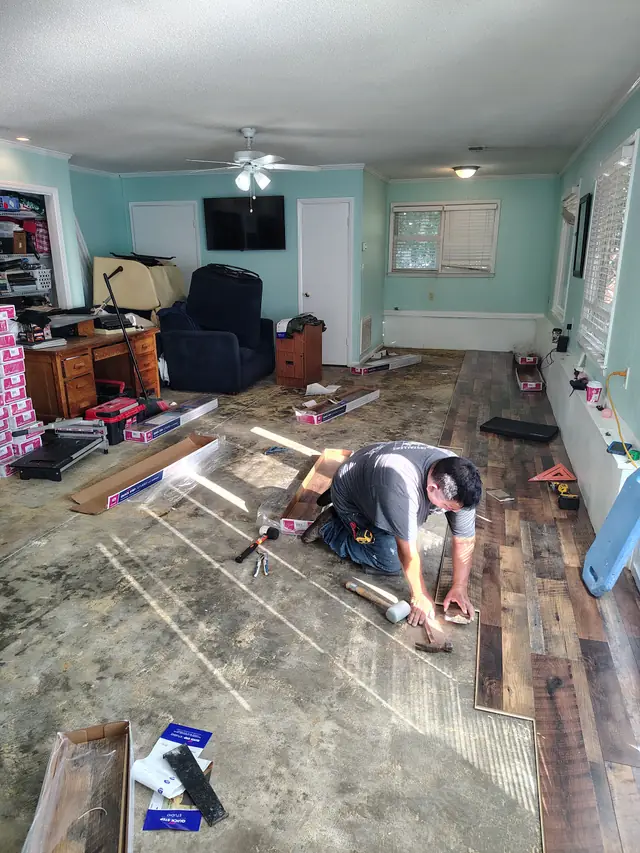
The job starts with the carpet and the pad coming up and the tack strips and staples coming out. Then Peter looks at what is left. The subfloor gets checked for flat, for loose boards, for anything that will print through, and corrected before an underlayment goes down. That step is the one most flooring quotes skip, and it is the one that decides whether the floor feels solid.
From there it is the product you picked. On their jobs you will see Quick-Step LVP being laid plank by plank on a stripped subfloor, Dream Home laminate going down over a protective sheet, and finished hardwood in an empty, well-lit room. Planks are staggered so end joints do not line up, a gap is held at the walls, and the cuts around door frames and vents are made so the trim covers the edge cleanly.
Joel Aguilar's Google review sums up how the crew works through a whole room: he had his shower redone in tile, the carpet removed and flooring installed, some drywall fixed, and all of it painted. One crew handling the floor and the walls around it means the baseboard, the paint line and the transition strip are all decided by the same person.
After the install: acclimation, cleaning, and what a squeak means
Plank flooring should sit in the room it is going into before it is laid, so it settles to the house's own temperature and humidity. If your boxes arrive a few days ahead of the crew, leave them in the room, flat, and do not stack them against an outside wall. Peter will tell you what your product needs before install day.
For daily care, sweep or vacuum with the beater bar off and clean with a product made for the floor type. Skip steam mops on LVP and laminate, because heat and moisture work their way into the joints. Felt pads under chair and table legs save more floors than any sealer.
A squeak or a hollow spot a few weeks in is information. A single spot usually points to a subfloor board that needs fastening. A line of small gaps along one wall usually means the room swelled or shrank and the edge gap is doing its job. If something looks wrong, call or text Peter at (478) 334-9344 with a photo and he will say whether it is normal movement or something to fix.