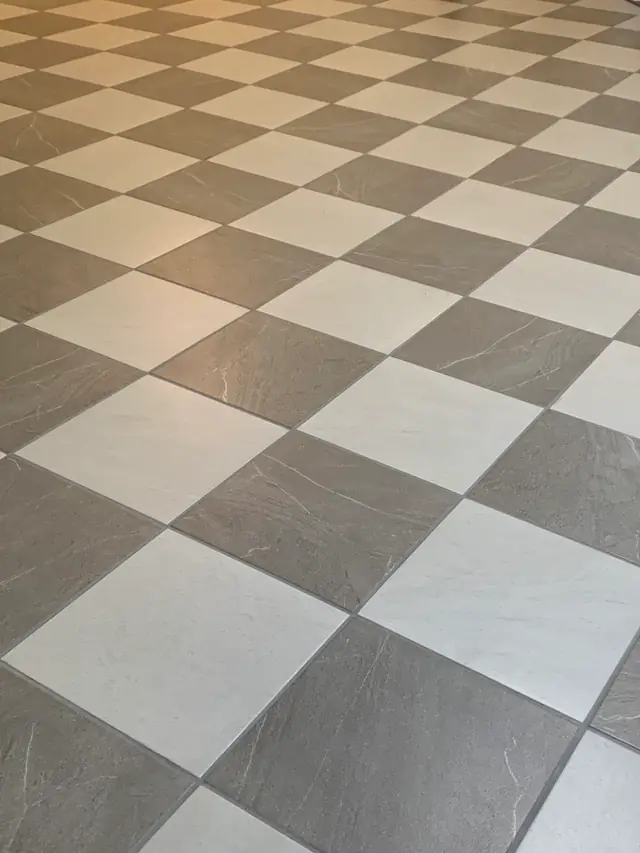
Why kitchen tile cracks, lips and wanders
A kitchen floor takes more punishment than any other tile in the house: dropped pans, a dishwasher that leaks once, a refrigerator that sits on four small feet. When tile fails here it is usually for one of three reasons, and none of them is the tile itself.
Lippage is the first. One tile sits a hair proud of its neighbour, and the edge catches a sock, a chair leg or a light from the window. It comes from setting tile on a floor that was never flattened, or from rushing the bed under the tile. The second is the crack that runs across several tiles in a line. That is a flexing floor underneath, and no amount of grout fixes it. The third is the grout line that drifts: parallel at one wall, a quarter inch wider at the other, because the layout started from a corner instead of from a plan.
Layout lines first, then the first tile
Before any thinset is mixed, Peter finds the centre of the room and snaps lines. Where those lines fall decides whether you end up with a full tile at the doorway and a thin sliver behind the stove, or cuts that are balanced and hidden where nobody looks. The checkerboard floor on their jobs, grey and white tile turned on the diagonal, is the clearest example: a diagonal set only reads as a pattern if the starting lines are true, because every tile after the first one inherits the error.
Square sets follow the same discipline with less drama. The floor is checked for flat, the tile is back-buttered where it needs it, and each course is checked against the line instead of against the last tile. The same method carries up the wall for a backsplash, where the horizontal grout lines have to meet the underside of the cabinets and the counter edge without a tapered cut at either end.
Hilton Coman's Google review of Peter and Daniel is for exactly this kind of work: they laid the tile for his kitchen renovation, and he says he would call them again. Granite and stone get the same layout treatment, with seams placed where the stone and the cabinets allow, not wherever the slab happens to end.
Sealing stone and living with grout
Natural stone is porous. Granite, travertine and similar stone should be sealed after install, and the seal wears with use, so a kitchen counter or stone floor needs resealing from time to time. A simple test: drip a little water on the surface. If it darkens the stone and sinks in, it is time to reseal.
Grout is the part of a tile floor that actually gets dirty. Wipe spills early, clean with a mild cleaner made for tile and stone rather than bleach or acid, and rinse. Sealed grout stays easier to clean, and darker grout hides a lot of cooking life.
If you ever see a hairline crack in a grout line, or a tile that sounds hollow when you tap it, send Peter a photo at (478) 334-9344. A small repair caught early is a morning's work. A tile left to break loose is a bigger one.