Pulling Up Carpet: The Subfloor Check Before LVP or Laminate
The floor under your carpet decides how the next floor behaves, which is why the check happens before a single plank goes down.
October 20, 2026 · 4 min read
Carpet comes up faster than almost anyone expects. A room that took a lifetime to feel settled is stripped in minutes, and then you are looking at the surface your new floor will actually sit on, maybe for the first time since the house was built. What is under there decides how the next floor behaves. That is why pulling up carpet is the start of a flooring job, not a footnote to it.
What you find under the carpet
Carpet hides a lot. There is tack strip nailed around the edges, staples through the pad, pad that has glued itself to the floor in patches, and sometimes an older floor underneath. In Houston County the base is usually a concrete slab or a wood subfloor over a crawlspace, and each one has its own habits. Before anything new is laid, every old fastener has to come out. A staple left behind shows up through a thin plank as a ridge, and the click-lock edge of that plank can work loose at exactly that spot.
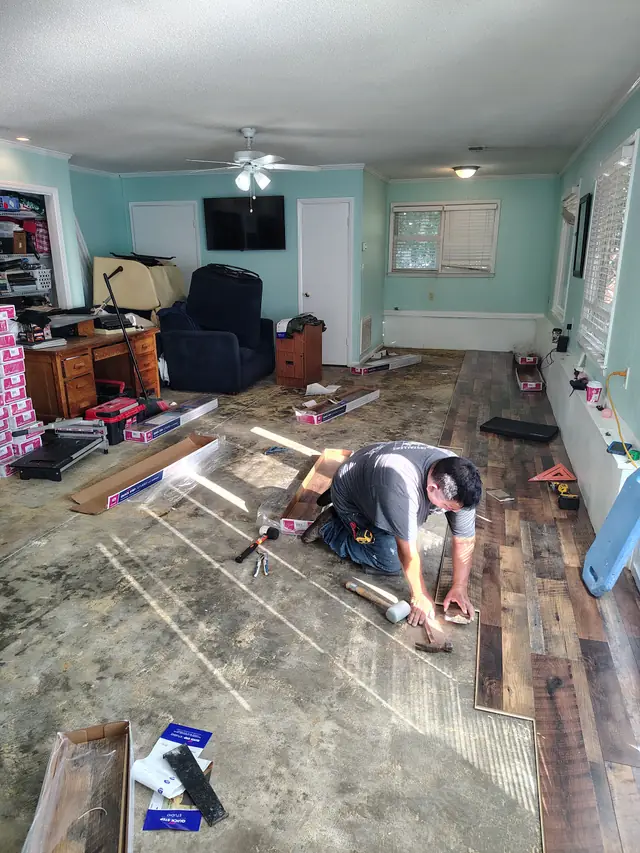
The photo on this site shows one of Peter's installers on his knees laying Quick-Step LVP over a stripped subfloor. The word that matters there is stripped. Nothing is left on the surface to hide a problem, which is how a proper install starts.
Flat matters more than new
Vinyl plank and laminate are usually installed as floating floors. They are not glued to the subfloor. The planks lock to each other and rest on top, which makes flatness the main requirement. Manufacturers print an allowable variation in their install instructions, measured over a span of several feet. A dip or a hump beyond that means the planks flex at that spot every time someone walks across, and the locking edges take the strain. Sooner or later they crack or open up.
Checking is simple and a little old-fashioned. A long straightedge goes down across the floor in several directions, and a flashlight held low shows shadows under it. High spots and low spots get marked. On concrete, high spots are ground down and low spots are filled with a leveling compound. On a wood subfloor, a sag is shimmed or built up and a hump is planed or sanded. Done with the room empty and the carpet gone, this takes little time. Done after the floor is down, it means lifting the floor.
Moisture and the slab
A concrete slab holds and moves moisture even when the surface feels bone dry. Carpet and pad let that moisture drift off quietly and also covered up any problem. A hard-surface floor is less forgiving. Trapped moisture can cup planks, bring a musty smell, or leave dark marks along the edges. The install instructions for most LVP and laminate products spell out how to check a slab and what underlayment to use with it, and those steps are worth following to the letter.
A wood subfloor over a crawlspace has its own checklist. Squeaks mean loose boards or plywood, and driving screws into them now is far easier than chasing the sound later. Dark stains where a pet had accidents or a bathroom once leaked need a close look, because the stain can sit on top of wood that has gone soft. A soft spot is not a flooring problem. It is a repair, and the damaged piece gets cut out and replaced before anything goes over it.
Why the check is worth the time
Skipping prep is how a floor looks perfect on the first day and starts to creak, gap or lift a few months later. Every one of those problems traces back to something that was visible, and fixable, when the carpet was first pulled. Here is what gets checked in a room before the first plank goes down:
- Every staple, nail and bit of tack strip removed, and the leftover pad scraped off.
- Flatness tested with a straightedge in more than one direction, with the high and low spots marked.
- A slab checked for moisture, or a wood subfloor checked for soft spots and squeaks.
- Door heights and thresholds, so the new floor meets the next room cleanly.
- Baseboards and door casings, and whether they come off or get trimmed so the planks can slide under.
One job, several trades
Carpet removal rarely stands alone. Joel Aguilar's review mentions Peter removing carpet and installing new flooring as part of a larger job that also included a tiled shower, drywall repairs and paint. That is common. Once the carpet is gone you see the baseboards that need replacing, the wall that needs patching, the room that wants a fresh coat before the new floor goes in. It is much easier to sequence all of that with one crew than to coordinate three.
If you are thinking about pulling up carpet, text Peter a photo of the room at (478) 334-9344 or call. Estimates are free, and the first question will probably be what is under the carpet now.
Master Flooring Installation & Home Repair, (478) 334-9344
Call (478) 334-9344More articles
What Goes Behind the Tile in a Shower That Lasts
A tiled shower is judged by its surface, but it lives or dies on the layers behind the tile.
Diagonal, Checkerboard or Straight: Choosing a Kitchen Tile Layout
The pattern you pick changes how the room feels, how many cuts it needs and where a mistake would show.