What Goes Behind the Tile in a Shower That Lasts
A tiled shower is judged by its surface, but it lives or dies on the layers behind the tile.
October 20, 2026 · 4 min read
Most people judge a tiled shower by what they can see: the tile, the grout color, the niche, the glass door. What decides whether that shower still looks good in ten years is the part nobody sees, the layers behind the tile. In Warner Robins, where a bathroom sits through long, humid summers, that hidden work matters more than most homeowners expect.
Tile and grout are not a moisture barrier
Tile itself barely absorbs water, so it is easy to assume a tiled wall is a sealed wall. It is not. The surface is hundreds of grout lines, and grout is a cement-based material with tiny pores. Water moves through it slowly but steadily, every time someone showers. Caulk in the corners ages and lets go. None of that means a shower is failing on day one. It means the tile layer is a wear surface, and whatever sits behind it has to cope with a steady amount of moisture without caring.
Older showers were often built with cement board or a moisture-resistant drywall behind the tile and little else. Cement board will not rot, but it still holds water, and it does nothing to keep that water from reaching the studs and the bottom plate. The tile looks fine for years while the framing behind it stays damp. By the time anything shows, the damage is usually well along.
Membrane or backer board: two ways to build the barrier
There are two common ways to put a real moisture barrier behind tile. The first is a membrane, a thin sheet or liquid coating applied over a conventional backer, with every seam, corner and fastener treated. The second is a foam-core panel that has the barrier built into it, taped and sealed where the panels meet. Both can produce a shower that lasts. Both fail the same way, which is when a step gets skipped: a seam left untreated, a corner not sealed, a screw driven through the barrier where it should not have been.
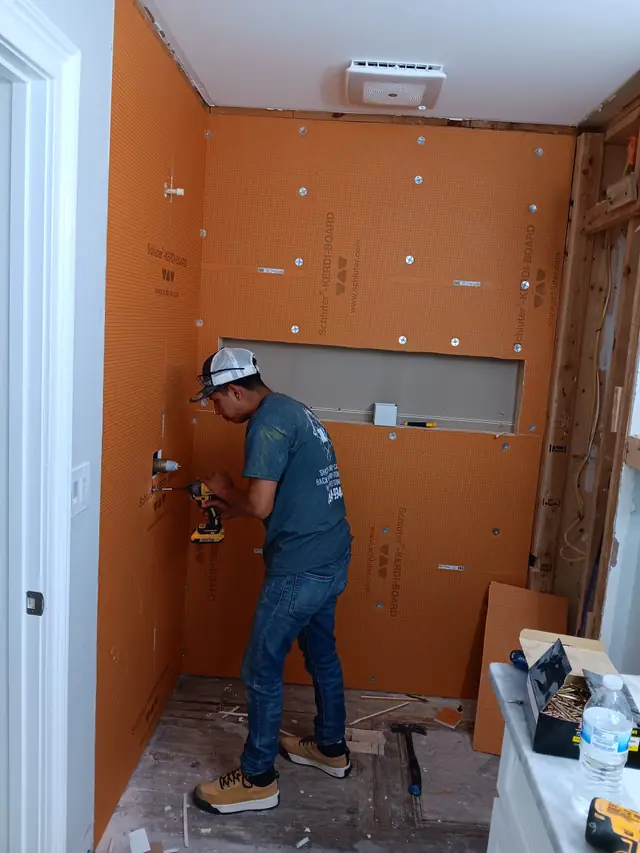
In the photo of a shower rebuild on this site, one of Peter's crew is fitting Schluter KERDI-BOARD panels to the walls before any tile goes on. That is Peter's habit on shower rebuilds, and it is the step most customers never see, because it is covered up the same week. A foam-core panel is also dead flat and easy to keep plumb, which gives the tile setter a better surface to work on.
The parts that matter as much as the wall
A barrier on the walls is only half of it. The floor of the shower has to slope toward the drain all the way across, with no flat spots where water can sit. Corners, where wall meets wall and wall meets floor, are places that will move a little, so they need flexible joints rather than rigid grout packed into them. Niches are the other trouble spot. A shelf set into the wall that sits level will hold a puddle against the tile all day, so a good one tilts slightly outward and has its own sealed seams.
Then there is the pan, the tiled floor of the shower. The finished shower on this site has a tiled pan, three stacked niches and a band of glass hex tile, and every one of those details is a place where water could get behind the tile if the work underneath was careless. Fancy tile does not change that.
Signs your shower is already in trouble
Most failing showers tell you before the damage gets serious, if you know what to look for. Check these a couple of times a year:
- A wall that feels soft or springy when you press it firmly with your palm, especially low down near the floor.
- Tiles that sound hollow when you tap them, tiles that have shifted or loosened, or grout that keeps cracking in the same place.
- A musty smell that comes back a day or two after you clean, even though nothing looks wrong.
- A stain, bubbling paint or a damp patch on the ceiling below the shower, or on the wall on the other side of it.
- Dark grout lines that no amount of scrubbing lightens, or caulk that keeps peeling and growing black.
One of these on its own can be a small fix. Two or three together usually mean water has been getting behind the tile for a while. A soft wall in particular is not something to caulk and forget, because it means the layer behind the tile is holding moisture and has to be opened up and looked at.
What a rebuild looks like
When a shower does need to come apart, the tile comes off, the damaged backer comes out, and anything wet or soft in the framing is dealt with before new panels go in. The customers who have had this done describe the same things. Annette Solis wrote that Peter was professional, careful and detailed, that he cleaned up after the job, and that the tiled shower came out beautiful. Joel Aguilar had a shower redone in tile and then had the carpet removed, new flooring installed, drywall fixed and everything painted.
If you are not sure whether your shower has a grout problem or a wall problem, send Peter a photo. Text it to (478) 334-9344, or call. Estimates are free, and a picture of the wall plus the ceiling below it is a good place to start the conversation.
Master Flooring Installation & Home Repair, (478) 334-9344
Call (478) 334-9344More articles
Pulling Up Carpet: The Subfloor Check Before LVP or Laminate
The floor under your carpet decides how the next floor behaves, which is why the check happens before a single plank goes down.
Diagonal, Checkerboard or Straight: Choosing a Kitchen Tile Layout
The pattern you pick changes how the room feels, how many cuts it needs and where a mistake would show.